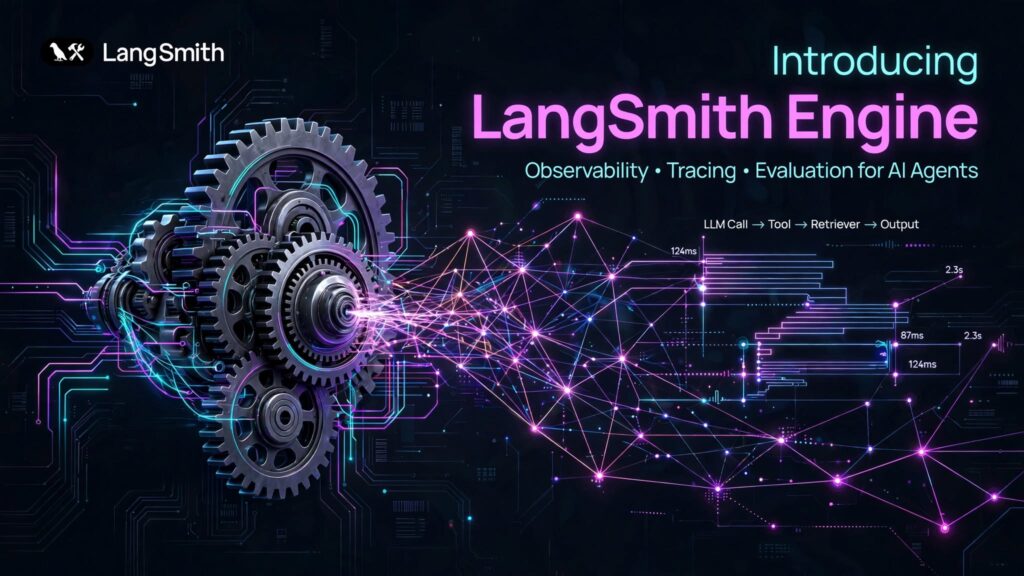
Here’s a question I keep hearing from clients: “Our agent works great in testing. So why is it acting weird in production?” Honestly, I never have a good answer in the moment. You dig through traces and squint at logs. Then you try to reproduce the one strange edge case a user hit three days ago. By the time you find the root cause, five new issues are waiting behind it. That’s why LangSmith Engine caught my eye.
LangChain introduced LangSmith Engine at Interrupt, and my reason for caring is pretty selfish. It tries to automate the part of my job I like the least.

What is LangSmith Engine, actually?
LangSmith Engine watches your agent’s production traces and tries to close the debugging loop on its own. It doesn’t just flag that something broke. It groups recurring failures into named issues. Then it reads the traces, and your source code, to figure out why they happen. Finally, it proposes a fix as a pull request.
Think about what that loop normally looks like. Someone notices a weird response. So you open LangSmith’s trace viewer and start digging. You find three or four traces that look similar. A hypothesis forms, and you poke at the code. Then you write a fix. If you’re disciplined, you also write an eval so it doesn’t come back later. That’s hours of work. It’s also the kind of work that’s easy to skip when you’re busy. And that’s exactly when quality problems quietly pile up.
Engine is LangChain’s attempt to make that whole sequence automatic. It runs in the background, on a schedule, across every connected project.
Why LangSmith Engine is worth paying attention to
According to LangChain, quality is the biggest thing stopping teams from scaling agents past the pilot stage. Not cost, not latency. Quality. That matches what I see with clients. The orchestration logic is rarely the hard part anymore. Knowing when and why your agent went off the rails is the hard part. And you need to know it at scale, across thousands of real conversations.
Engine attacks that from a few angles at once. First, it clusters failures instead of showing them one at a time, so you see the pattern, not the noise. Next, it generates online evaluators scoped to a single issue. That way you can actually measure whether a fix worked. It also pulls the failing traces into a dataset for offline testing. And if an issue comes back after you thought it was fixed, it reopens on its own.
That last part is the one I find most interesting. Most teams I work with are good at fixing a bug once someone complains. Almost nobody notices when the same bug sneaks back in a slightly different shape two weeks later. Engine is built around exactly that blind spot. It reminds me of the Reflexion pattern I wrote about recently, where an agent catches its own mistakes. But here the loop runs at the system level, not inside a single run.
A healthy dose of “it’s still beta”
LangSmith Engine is in public beta right now, and I’d treat it that way. Look at what it does. It reads your production traces and your source code, then opens pull requests against your codebase. That’s exactly the kind of tool you want a human reviewing closely before anything merges. The first analysis run reportedly takes around 20 minutes too. So this isn’t instant magic. It’s more like hiring a very fast, very literal junior engineer whose only job is triage.
I also don’t think it replaces the judgment part of debugging agents. Some failures really matter to your business. Others are just noise from an edge case nobody cares about. Telling them apart still takes a human who understands the product. What Engine seems built to remove is the boring part. That means the clustering, the trace digging, and the “where do I even start” problem.
I’m planning to wire this up on one of my own LangGraph projects over the next few weeks. I want to see how it behaves against real production traffic, not a demo. If it holds up even half as well as the pitch, that’s a big shift for me. Less time babysitting agents, more time building new things.
So here’s my question for you: would you let an agent open PRs against your production agent’s code? Or is that a line you’re not ready to cross yet?
Happy debugging, and I’ll report back once I’ve put it through its paces.